
PAST EXHIBITIONS
2026
%202.jpg)
Dark Days | January
Rafael La Madrid
In Dark Days, one of the two exhibitions opening 2026 for Art Cube, Rafael La Madrid turns to nature not as a sweeping vista but as something closer, more granular, and quietly insistent. His attention settles on the small and the often overlooked, allowing fragments of the natural world to carry the weight of reflection and endurance.
%202.jpg)
Where The Land Becomes Still | January
Jep Dizon
In Where the Land Becomes Still, one of the two exhibitions opening 2026 for Art Cube, Jep Dizon offers his latest exploration of landscape painting—one that resists the genre’s habitual calm and instead presses it into unfamiliar territory. What he terms “hybrid landscape art” unfolds through the careful interweaving of landscape with other painterly traditions, notably still life and portraiture, allowing scenes to hover between place, presence, and objecthood.

A Field Guide to Navigation | February
Eri Abe
Roads have long been considered foundational physical markers of advancement. They form channels through which movement flows—connecting places, bridging different cultures, shaping civilizations, and allowing the passage of people, stories, and goods.

Still | February
Arel D. Zamabarrano
In STILL, Arel Distor Zambarrano presents two interconnected bodies of work that examine measurement, perseverance, and grounded positivity. The exhibition centers on the titular STILL, a 15-piece polyptych of considerable proportions, and Optimism Underpinned, a suite of 30 smaller works. Together, they articulate a practice shaped by discipline yet animated by motion, steady and forward-looking.

Pagmamahal | February
Demosthenes Campos
Demosthenes Campos' Pagmamahal means love in Filipino, but in everyday conversation, it also signals something becoming more expensive. The dual meaning is tangential to this exhibition, because in a time when the pace of life accelerates at such a rush that we can barely cope and the cost of living continues to rise, what does it mean to speak of love? Has it, too, become something difficult to sustain? Can we still afford to love and be loved?

FMLA | March
Julio Jose Austria
To encounter Julio Jose Austria’s paintings is to recognize them not as fixed endpoints, but as traces—residual evidence of a life negotiated across geographies, labor, and care. In this sense, his practice recalls the expanded ethos of Joseph Beuys, for whom the artwork functioned less as an autonomous object and more as a document of lived experience and social reality. Austria’s canvases operate similarly: they are records of endurance, migration, and interior weather.

Don Bryan Bunag | February
Don Bryan Bunag
In Inhabitants, Don Bryan Bunag extends painting toward the condition of an inner environment—one that feels uncannily close yet remains fundamentally unreachable. Inflected by Immanuel’s Kant thought of “inner sense,” the means by which we perceive and represent the various states of the mind, the works situate the viewer before spaces that resemble thresholds, cosmic events, and scenes on the verge of transformation: domains that seem to recognize us, even as they seem estranged.

Pastilan | March
Rey Labarento
Duality in life does not necessarily mean two distinct beings or situations. Sometimes it’s the same thing seen differently, meant differently. Visayan visual artist Rey Labarento explores this relationship in the exhibition “Pastilan.”

You. I. Luv. | March
Ian Inoy
YOU. I. LUV. examines and enacts resilience as a historically produced condition shaped by colonial legacies, structural violence, and collective trauma. Grounded in the Filipino experience, the exhibition draws from postcolonial and trauma studies to question how resilience has been normalized as both a cultural expectation and a survival strategy. Rather than framing resilience as an innate strength, the exhibition asks how it is learned, imposed, and sustained across generations.

Seams of Memory | March
Winna Go
In Seams of Memory, a major exhibition that gathers her recent works alongside a selection of early highlights, Winna Go (b. 1997) offers a generous view of her evolution as an artist, revealing a practice that mediates between Chinese and Filipino cultures, tradition and contemporaneity, longing and the idea of home. Organized by Art Cube and comprising 15 large-scale works, the exhibition contemplates the ways the two cultures are bridged—by memory, by material, and by the waters that once welcomed those who journeyed from the mainland to the archipelago.
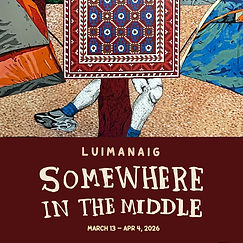
Somewhere In The Middle | March
Lui Manaig
The middle isn’t glamorous. It’s not the thrilling beginning, all urgency, freshness, and newness. It’s not the victorious finish line either. It’s the somewhat capricious stretch in between, the part where you pause, look around, and realize you’re still figuring things out. For a visual artist, this space can feel surprisingly and achingly fragile. There’s momentum, yes, but certainty? Rare.

Plan B | April
Groupshow
The eleven artists in this exhibition share an understanding that things do not always go as intended, and that proceeding anyway requires a particular kind of grace. There is a phrase in Filipino that captures this: magaling magdala. It is the compliment you give someone who walks into a difficult situation and makes it look effortless. Someone who knows how to carry themselves, how to hold complexity without showing the strain, how to pivot when the ground shifts and make it seem like they intended to end up there all along. The works in this exhibition do not dwell on what went wrong with Plan A. They simply demonstrate what it looks like to have moved on.

Unplanned Spaces | May
Groupshow
Painting is a slow form. It resists the pace of everything around it — the accelerated image culture, the speed of information, the feeling that the world is constantly mid-revision. To choose it, especially now, is not nostalgia. It is a particular kind of resolve.

Terraforming | April
Nina Garibay
In Terraforming, Nina Garibay constructs a visual archaeology of power, how it is formed, imposed, inherited, and ultimately undone. Drawing from archival images of Egyptian, Bronze Age, and medieval Christian origin, many sourced from institutional collections such as the British Museum, the Vatican Museum and the Cairo Museum, her paintings assemble civilizations into composite fields where time collapses and authority reveals both its continuity and its limits.

Pitik-Pitik | May
Abril Dominic Valdemoro
In Masbate City, where sculptor Abril Dominic Valdemoro grew up, construction workers moved through neighborhoods like anonymous engineers of survival, arriving for work with improvised tools, patched equipment, and a knowledge of structure carried almost entirely by the body. As a child, Valdemoro watched them with fascination as not only humble laborers, but as friends, idols, and builders of worlds.

Taliwala | May
Jessa Balag
Taliwala is a Cebuano word that refers to being in the middle, the space between departure and arrival. Balag began production for the exhibition by asking herself a simple question: why do people travel, and where are we all going? Behind every trip is a reason that cannot always be seen. Some travel to work, to provide. Some leave home carrying food, gifts, or necessities for others. In these works, travel is shown as an act tied closely to responsibility, love, devotion, and hope. And that special package you carry from one point to another.

Gathering | May
Martin Honasan
Gathering brings together sculptural works, two large-scale canvases, and a series of works on paper. Across the exhibition, traditional acrylic painting is combined with reclaimed fabrics—old T-shirts, canvas, and a tablecloth—hardened, collaged, and reworked. These materials carry prior use within them, allowing each piece to hold traces of touch, repetition, and time.

Palumpalo | June
Joey Cobcobo
In street slang, palumpalo describes an intense wanting. It can mean being hyper, eager, determined, completely captivated by someone or something, or in words spoken in jest in dark alleys, pasitib. The word contains a sense of pursuit, of reaching beyond what is already in front of you. And for Joey Cobcobo, it speaks to a mindset that has shaped both his life and his artistic practice.

Even the Light Can Sing | June
Billy Bagtas
You may have always believed that darkness is not simply the absence of light, but a place one must pass through like a long storm before summer. In the works of Billy Bagtas, darkness feels alive, restless, and stubborn, much like the human heart when it refuses to give up. Purple bleeds into green; blue trembles beneath the shadow. These colors intend to ache, to be remembered, they insist on being felt. Yet within that heaviness, something brave begins to stir, a small, determined glow, as if light itself has found the courage to sing.

Forgetting | June
Groupshow - SAYSAY COLLECTIVE
For the artists of Saysay Collective, forgetting is not simply about loss: sometimes it is healing, or a defense mechanism. At other times, it serves as a warning, catalyzes transformation, or even evokes a harbinger of things to come. Named after the Filipino word saysay, meaning significance or meaning, the collective brings together an intimate number (only five as of now, easy to handle, fun to debate with) of talented artists from different backgrounds and previous home bases. After crossing paths during their time at Linangan Art Residency, they discovered shared interest in making artworks that respond to the world around them, trying to make sense of things.

Alaala ng Lupa | July
Joshua Limon Palisoc
It is this quiet understanding that informs Alaala ng Lupa, Joshua Limon Palisoc's fifth solo exhibition. After the passing of his mother, the artist found comfort in the thought that she had not simply disappeared, but had returned to the natural world. The exhibition turns to nature not only as a place of mourning, but as a source of renewal.

We're All Going to Die Anyway | August
Wyndelle Remonde
Wyndelle Remonde's recent works push his visual language to its limits. His practice has long embraced the ironic sensibilities of lowbrow art, where cartoon imagery often functions as satire, nostalgia, or detached humor. In We're Going To Die Anyway, Remonde's eighth solo exhibition, those familiar visual codes carry a different weight. Irony gives way to urgency as every image is propelled by the simple realization that time is finite. Painting, for Remonde, becomes an insistence on being present. "Life is too short not to do the things that make us happy," he says. "We're all going to die anyway, so we might as well enjoy life."

Kinabuhi | July
PJ Cabanalan
Kinabuhi, the Hiligaynon word for life, reflects on what years of practice have made visible. Rather than understanding life as a succession of achievements, Paul John Cabanalan sees it as a process of becoming. Clarity is earned through repetition, confidence through sustained work, and only in looking back does the path begin to reveal its own coherence.

Unruly Matter | August
Winner Jumalon
Winner looks at the objects around him with a renewed, relentless curiosity. A sliced lemon resting in glass, a ceramic pitcher, a bundle of dried stems, a blue mirror framing his own face. In another context, these are still lifes set up for quiet observation or formal copying. Instead, they have become immediate artifacts of his domestic life, drawn from years engaged in fatherhood, experiences which do not come wrapped in an ikebana-like arrangement, but behave more like an overgrowth, spreading across memory like mold or mushrooms claiming new ground.

Build Breed Bleed | July
Ciron Señeres
Build, Breed, Bleed, takes its structure from three pivotal moments in the Bible that also parallel the cycles of human life. Build begins with God's creation of the world: “In the beginning God created the heavens and the earth” (Genesis 1:1). Breed recalls God's first command to humanity: “Be fruitful and multiply” (Genesis 1:28), extending creation through human continuity. Bleed points to the entrance of sin into the world through Adam (Romans 5:12), introducing mortality, suffering, and the enduring consequences of human choice.
.jpg)
Where Light Falls | August
Kristone Capistrano
Filipino-Australian artist, working across traditional and experimental drawing, Kristone Capistrano approaches light not as illumination alone, but as a condition in which time, materiality, and perception converge. He foregrounds these images as tactile experiences, where layers amass through staining, tearing, and repair, as the artist suggests, expressions that retain the traces of the human touch. These actions allow the surface to register both gesture and duration, through charcoal or ink, and collages on banana paper, as seen here.

HeadSpace | August
Daniel Aligaen
Daniel Aligaen took up Fine Arts at the University of Santo Tomas and has been painting professionally since 2007. He initially created his work using pen and ink, and now works primarily in oil and acrylic.
Throughout his eighteen years of painting, his fascination with geometric shapes continues to show in his work, while his style has evolved to include other elements and narrative characters. Moving beyond plain canvas, Aligaen has explored using various textiles to breathe new life into these geometric forms.

Deus Machina | September
Mike Adrao
In his solo exhibition, Deus Machina, Mike Adrao proposes that the machine itself—the systems at work in our everyday lives, whether in finance, religion, or technology—is, in itself, the god: omnipresent, self-contained, and seemingly indestructible. Through his works, Adrao considers how these seemingly distinct forces have joined and commingled into one vast god-machine, whose gravity is virtually inescapable.In a series of monochromatic works in charcoal, Adrao fashions religious iconography from the patterns and motifs found in defunct currency bills.

Olor | September
Hermes Alegre
In this series of new works for his solo exhibition, Olor, a Spanish term meaning a whiff or scent, Alegre shows how he loves women through his particular depiction and subjectivity: clear-faced, composed, and in tune with the natural elements of fruits and flowers. His women are immediately recognizable as Alegre women—idealized, certainly, but never remote; beautiful without seeming fragile, and serene without losing their presence. Much of this allure comes from Alegre’s use of color. His palette is lush but carefully controlled, moving between the warm earthiness of the women to the saturated reds, greens, yellows, and pinks of the natural world.

Sa Pagitan ng Bangugnot at Bahaghari | September
Jeho Bitancor
In his solo exhibition, Sa Pagitan ng Bangungot at Bahaghari, Jeho Bitancor plumbs the space in between the nightmare and the rainbow—the latter being a sign of hope, renewal, and the possibility of something better. The nightmare alluded to in the title may be located in a particularly dark chapter of our history, but for Bitancor, it also points to a larger socio-political inheritance: how decisions made by dictators and strongmen of the past continue to shape the present, and how certain societal ills—poverty, inequality, and injustice—remain stubbornly persistent.

Sinagtala | October
Joen Sudlon
In his solo exhibition, Sinagtala, Joen Sudlon brings the luminosity of starlight to a suite of works that allow stories to emerge through glass. By etching marks onto its surface, Sudlon coaxes hidden images into view: first as multicolored strokes, and, when illuminated, as contours of light.This process becomes particularly symbolic of works in which the ordinary is charged with self-mythology. Human beings become vessels of secrets and mysteries, transforming themselves through dreams and desires as they navigate the vastness of the world—its oceans and landscapes, as well as the uncharted territories of the self.

Dwelling Place | October
Noel Elican
Noel Elicana’s latest solo exhibit explores a very personal take on what one might consider as habitation, where one finds a sense of identity and belonging, of familiarity and comfort. Going beyond the concepts of space and place, the exhibit looks into both location and persona: location as a metaphorical perimeter where one’s imagination is free to roam and contemplate realities outside and reflections within; the persona as both emphatic Self and Other creating a symbiosis of belongingness and security.

Sa Katiyakan ng Pagsikat ng Araw | October
Archie Oclos
When visual artist Archie Oclos (b. 1989) learned of his father’s passing in 2024, he returned to Brgy. Tinago, Catanduanes, the farming community where he grew up. The journey home required a thirteen-hour drive and a three-hour ferry crossing to the small island facing the Pacific Ocean. It also meant returning to a landscape shaped by typhoons, rural poverty, and the precarious conditions of agricultural labor. As the son of an abaca (Musa textilis) farmer, Oclos’ relationship to this place is inseparable from the material itself.