top of page

FMLA
Julio Jose Austria
March 13 - April 4, 2026


1/6
FMLA
To encounter Julio Jose Austria’s paintings is to recognize them not as fixed endpoints, but as traces—residual evidence of a life negotiated across geographies, labor, and care. In this sense, his practice recalls the expanded ethos of Joseph Beuys, for whom the artwork functioned less as an autonomous object and more as a document of lived experience and social reality. Austria’s canvases operate similarly: they are records of endurance, migration, and interior weather.
Austria belongs to a generation of immigrant artists who arrived in New York City with both ambition and necessity. For many, the city carries the aura of a cultural capital—a proving ground as much as a destination. Raised in a working-class family in the Philippines, the son of a music professor and an engineer, Austria migrated without generational wealth or institutional backing. He was the first in his family to build a life abroad. That trajectory—marked by risk, discipline, and obligation—forms the emotional substratum of his work.
His early impressions of New York persist in the palette and atmosphere of his paintings: concrete grays, industrial shadows, sedimented dirt, and the compressed light of a skyline where open sky feels rationed. The “concrete jungle” is not rendered descriptively; rather, it is metabolized into texture and tone. Austria does not paint the city so much as he paints through it. His compositions resist direct representation, instead assembling fragments of memory from oscillating returns between New York and Cavite, Philippines. These canvases become sites of overlap—between departure and return, density and openness, fatigue and release.
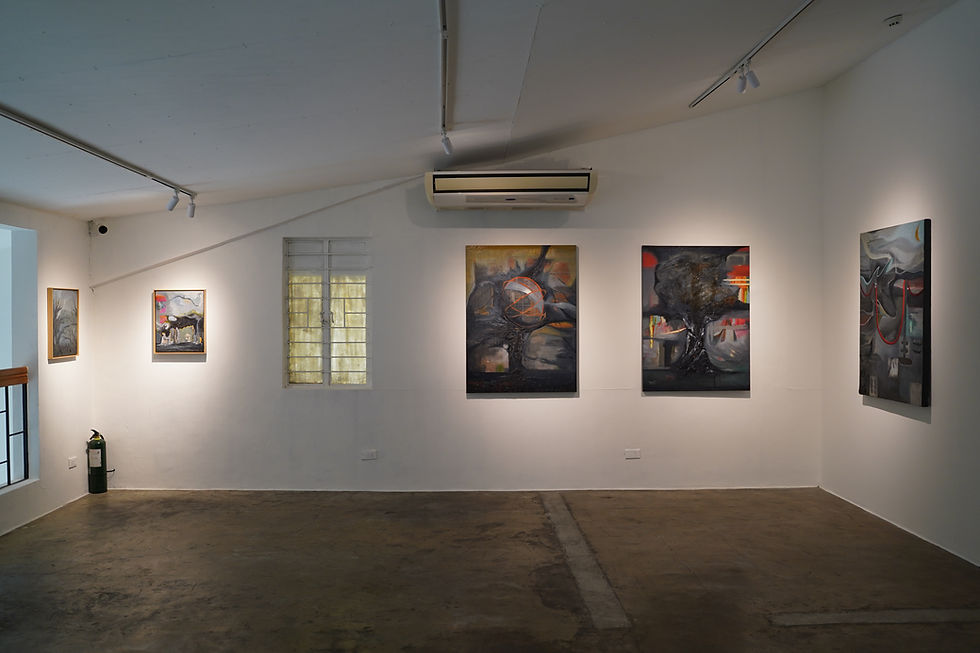
In the work entitled Algorithm of Decay (oil on canvas), this condition of labor becomes both image and allegory. The painting suggests the impression of a carabao—its silhouette indistinct, nearly dissolving into the field it labors within. There is no definitive form, only the sense of a body working endlessly: waking in the morning, returning at night, and continuing to plow without pause. The exhaustion of a laborer worked to death is not depicted literally. Instead, Austria turns to symbolism. Much like Guernica by Pablo Picasso—where the brutality of bombing is not shown directly but refracted through horses and bulls in chaotic anguish—Algorithm of Decay refuses illustration. The carabao becomes an emblem of cyclical endurance, of a body subsumed by obligation. Its fading contour suggests not only physical depletion but the slow erosion of identity under repetitive strain. The “algorithm” here is routine itself: wake, labor, return, repeat. Decay is not sudden—it is cumulative.
Though comparisons may be drawn to the anxious yet playful surfaces of New York–based painter Joe Bradley, Austria’s visual language is distinctly his own. His brushwork vacillates between tension and improvisation. Fields of muted color are interrupted by gestural marks that feel at once urgent and searching. The paintings hold uncertainty without collapsing into despair. They stage vulnerability as an active condition—one that allows for moments of levity, even joy. For Austria, painting is not an escape; it is the one medium capacious enough to contain exhaustion alongside hope.
The title FMLA sharpens this interplay between abstraction and lived reality. In the United States, the Family and Medical Leave Act grants eligible workers time away from employment to care for an immediate family member. Austria, who for over a decade supported himself as a staff member at the Museum of Modern Art, invoked this policy to care for his mother after she suffered a stroke and became bedridden. The leave allowed him to accompany her to medical appointments and assume the role of caregiver for several months.
The bureaucratic language of “leave” acquires layered meaning here. A leave of absence from work becomes a return to familial duty; a physical absence from the studio registers as a different kind of presence within the paintings themselves. The works in this exhibition bear the imprint of that divided temporality—the strain of sustaining an artistic practice while laboring for survival abroad and tending to loved ones at home. Austria’s experience resonates with the broader condition of many working-class Filipino migrants, for whom mobility is both opportunity and sacrifice, and for whom distance is measured in remittances, phone calls, and deferred rest.
In Austria’s hands, abstraction becomes a form of testimony. His canvases do not illustrate biography; they absorb it. What remains is a surface charged with negotiation—between cities, between roles, between grief and perseverance. The paintings insist that presence is not singular or stable. It is something assembled, contested, and, ultimately, painted into being.
-Jevijoe Vitug

bottom of page