top of page

forgetting
SAYSAY Collective: Panch Alvarez, Carlo de Laza, Elwah Gonzales, KR Rodgers, and Ben Simbulan
June 6 - June 27, 2026


1/7
Between Memory and Oblivion
We usually experience remembering through rose-colored lenses, much like memories in our social media pages edited, filtered, and saturated, tainted with the warm sepia tingles of nostalgia. We love reliving the good times, reminiscing while keeping in mind our individual lore and origin stories. We are also advised to call to mind the lessons we learn every day, but, since not everything can stay with us, the simple truth is this: forgetting is just as much a part of life. While some memories fade on their own, others become too heavy to bear, and we must leave them behind for us to survive.
For the artists of Saysay Collective, forgetting is not simply about loss: sometimes it is healing, or a defense mechanism. At other times, it serves as a warning, catalyzes transformation, or even evokes a harbinger of things to come. Named after the Filipino word saysay, meaning significance or meaning, the collective brings together an intimate number (only five as of now, easy to handle, fun to debate with) of talented artists from different backgrounds and previous home bases. After crossing paths during their time at Linangan Art Residency, they discovered shared interest in making artworks that respond to the world around them, trying to make sense of things. They are of one heart and mind that in Forgetting, memory becomes both a personal and social question: what do we choose to keep, and what are we willing to let disappear?
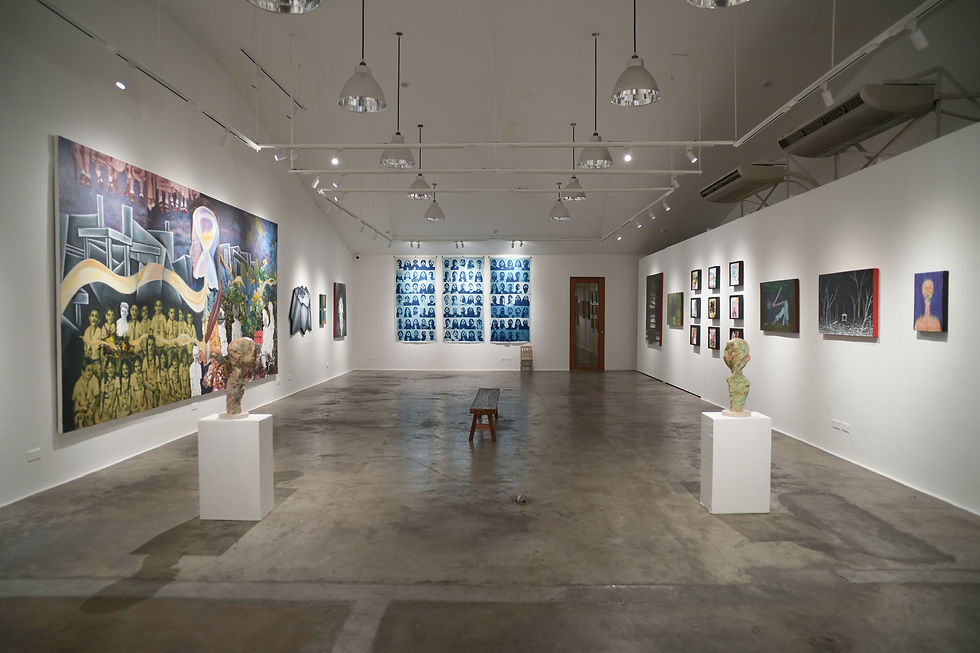
To initiate a genesis of answers, Panch Alvarez marks his pieces with feathers, symbols of flight, freedom, renewal, and lightness, using ink and flowing pigments to reflect on grief, hope, and the quiet process of letting go. He also presents Mebuyan, caretaker of departed infant souls, amongst her children, embodying remembrance as an act of unconditional care, suggesting that even what has left the world continues to be held, nourished, and loved. Carlo de Laza's seven cast marble busts, A Spectre of What Was I-VII, begin from the same source yet emerge transformed, shaped by pressure, time, and the marks left behind by the sculptor's experienced hands. With patina and varying applications of warm tones, we are surprised to sense movement and life underneath their cold, hard skins. For her part, Elwah Gonzales turns to fire as a recurring image, treating it as both destruction and rebirth, a force that burns yet also clears the way for something new. From a tiny ember to small flames, either enclosed in rooms as in Everything I Couldn’t Carry Caught Fire, held by a hand suppressing self-expression, or creating a fierce blaze in a dainty crown showing glow and spirit, things bode well until a figure succumbs to complete combustion due to burnout or self-immolation brought about by bad life decisions. KR Rodgers builds imagined structures, monuments, and Passages that keep strongly rooted family, memory, and the people he does not want time to erase. In pen and ink or acrylic paint on shaped wood panels or canvas, he uses landscapes from both urban densities and idyllic fields to hold his figures, some members of his family uncannily appearing as his clones. Recently-specially-cited Ben Simbulan looks to shared experiences, family photographs, friendships, class pictures, and childhood dreams, finding in them the warmth, comfort, and optimism of possibilities, of collective memory. He contrasts this, however, in Yakap, where a lone figure is seemingly finding it particularly challenging to let go and keep moving.
The talents of Saysay Collective's artists come together in Entropy, a large collaborative work that takes its title from the scientific idea that all things naturally move from order toward disorder. A central figure who appears somehow to be a knight or a cyber warrior with an hourglass embedded in his head is reminding us of time passing. Concrete structures provide a visual anchor, but in their disorderliness might not provide reliable shelter. Class photos and groups of children remind us of innocence, hope, and dreams, while the right side of the monumental 96 x 192-inch piece has elder figures reminding us of aging and facing the twilight of our years confidently and with courage. These images are anchored by a string of forget-me-nots, blue flowers that provide calm and clarity against a night sky filled with stars crossed by floating ethers. Red stripes also appear amongst scumbles resembling pockets of flames, swathes of earth, and clumps of foliage, not only in this large piece, but threading in harmony with all the crimsons used by the artists in the exhibition whether as underscore, canvas sides, or haphazardly left flowing. As a whole, the piece reflects on a world overwhelmed by information, distraction, and the habit of forgetting, asking what happens when societies lose sight of their histories, especially when it allows injustice and abuse to repeat themselves. Then, and only then, perhaps we can let collective amnesia offer a balm, a social sedative essential to survival.
Yet this exhibition is not entirely about the disappearance of details and figures, and letting go. Running through these works is the belief that memory persists in fragments: in stories, in images, in objects, in the art we create, and in the people who carry them forward. Forgetting may be inevitable, but meaning can always still be made from what remains. Perhaps that is what the immensity of these collective and collaborative works is truly about: not memory alone, and never forgetting alone, but finding the space between them, interstices where we continue to make sense of ourselves, our narratives, our dreams and yet-unrealized goals, and making the most of the time we have been given.
- Kaye O'Yek
SAYSAY COLLECTIVE
Art, at its core, is the bridge between the tangible and the metaphysical—a relentless force that propels individuals and societies into constant transformation. It confronts decay not with resistance, but with persistent creation. In its purest form, art challenges the norm, defies stagnation, and insists on progress. Rooted in this philosophy is the Saysay Collective.
Named after the Filipino word saysay, a term that denotes “meaning” or “significance,” the group centers its vision on the belief that art should not merely reflect the world but react to it. The collective’s works are conscious responses to the urgencies of contemporary society—acts of creation born out of critique and a longing for meaningful change.
Comprising artists from a wide range of disciplines, economic backgrounds, and geographic origins, the Saysay Collective is a convergence of diverse voices united by a shared purpose: to disrupt indifference and encourage dialogue. Each member brings a unique lens that amplifies the collective’s message and broadens its impact.
In a time marked by cultural unrest, social inequality, and rapid change, the Saysay Collective stands as a testament to the power of artistic dissent. It challenges audiences to confront discomfort and find meaning beyond the surface. More than a group, the Saysay Collective is a movement—a community of creators driven not just to make art, but to make a difference.

bottom of page