top of page

Unplanned Spaces
Hanna Sayam, Jack De Castro, James Barbecho, Kendall Colindon, Kim Gaceja. Marvin Quizon. PJ Andayran, RC Caringal, Tony Mercado


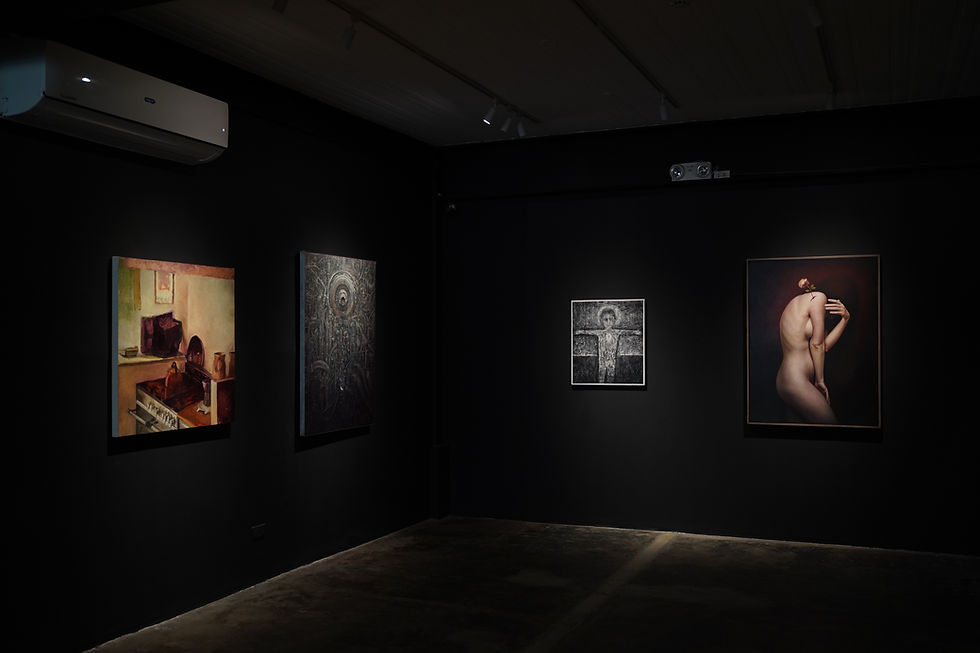
1/7
Into the Unplanned
Painting is a slow form. It resists the pace of everything around it — the accelerated image culture, the speed of information, the feeling that the world is constantly mid-revision. To choose it, especially now, is not nostalgia. It is a particular kind of resolve.
But painting is also, by nature, a practice of the unplanned. You build the discipline, the observation, the accumulating mastery — and then you stay open to what the process discovers on its own. This tension between commitment and receptivity, between what the painter intends and what the canvas insists on becoming, is where painting lives. Unplanned spaces are not failures of control. They are where the real work happens.
The ten painters here are mostly young, all of them working through a moment that has not been easy to work through. What holds them together is less a shared subject than a shared orientation: toward the personal as genuine inquiry, toward the body, memory, and ordinary feeling as legitimate artistic material.
Hanna Sayam’s human-animal hybrids indict the systems that reduce bodies to utility. In Hallow / Hollow (2026), a haloed, wounded figure floats amid objects that are both bounty and burden — the halo less a benediction than an accusation. A Bloom That Bites (2026) collapses the nurturing and the predatory into one creature. Under capitalism, Sayam suggests, these were never opposites.
Kendall Colindon’s Mga Daluyan ng Uhaw (2025) renders progress as loss — vessels of sustenance accumulated into a mass that is at once monumental and mournful, the blue not of abundance but of thirst, of what development quietly displaces and paves over.
Jack de Castro’s The Bloom After Pain (2025) is painting as physical reckoning. His wilting flowers are memento mori in the oldest sense: beauty in the act of failing, the gesture itself wringing both release and elegy from the same mark.
PJ Andayran’s Dailies (2024) wears its critique lightly, which makes it sharper. Two costumed animal figures in an ambiguous field — pasture or mall atrium — use satire not to ridicule from a distance but to implicate, to make the familiar strange enough to finally see.
R.C. Caringal’s One’s Devotion (2024) is as much self-portrait of process as it is subject. To paint hands with this much material insistence — pigment accumulating into something between image and sculpture — is to make the act of painting itself visible. For Caringal, to paint is to act, to shape, to claim agency with one’s own hands.
James Barbecho’s Echoes of Lullaby (2025) places human fragility inside overwhelming mechanical complexity. The title’s tenderness — a lullaby — sits against the image’s cold geometry like a whisper inside a machine, asking what survives of human warmth when the systems we build grow too intricate to feel.
Marvin Quizon’s Weight of Wisdom (2026) works in sepia — the palette of retrieved memory — placing a female figure at its center as allegory rather than spectacle. Wounds here are not merely scars but openings, painful and generative at once, the body as a site where psychological history is both carried and transformed.
Kim Gaceja’s The Quiet We Inherit (2025) understands that the mundane is not the opposite of the profound but often its most reliable address. His domestic interiors — a record player, earthen vessels, particular light — are externalizations of a mental sphere where quiet connections and small epiphanies accumulate into meaning.
Tony Mercado’s Suddenly, My Flowers Withered (2026) closes the show at a threshold with no clean resolution: pink blooms against rough gray, caught at the precise moment of their failing — beauty on its own contingent, urgent terms.
Painting, at its most necessary, is how some people cope with a world that won’t hold still — how they navigate it, question it, refuse to be merely subject to it. These ten painters are doing exactly that: building a practice as open to surprise as it is committed to rigor. The unplanned spaces in their work are not absences. They are where the conversation with the world is most alive.
-AG

bottom of page