top of page

Alaala ng Lupa
Joshua Limon Palisoc
July 4 - July 25, 2026


1/6
Where Memory Takes Root
The earth remembers differently from people. It keeps no names, yet nothing is ever truly lost. Trees that fall return to the soil. Rivers carry traces of mountains worn away by time. Bodies entrusted to the ground nourish roots from which forests, flowers, and fruit emerge. Memory survives through transformation.
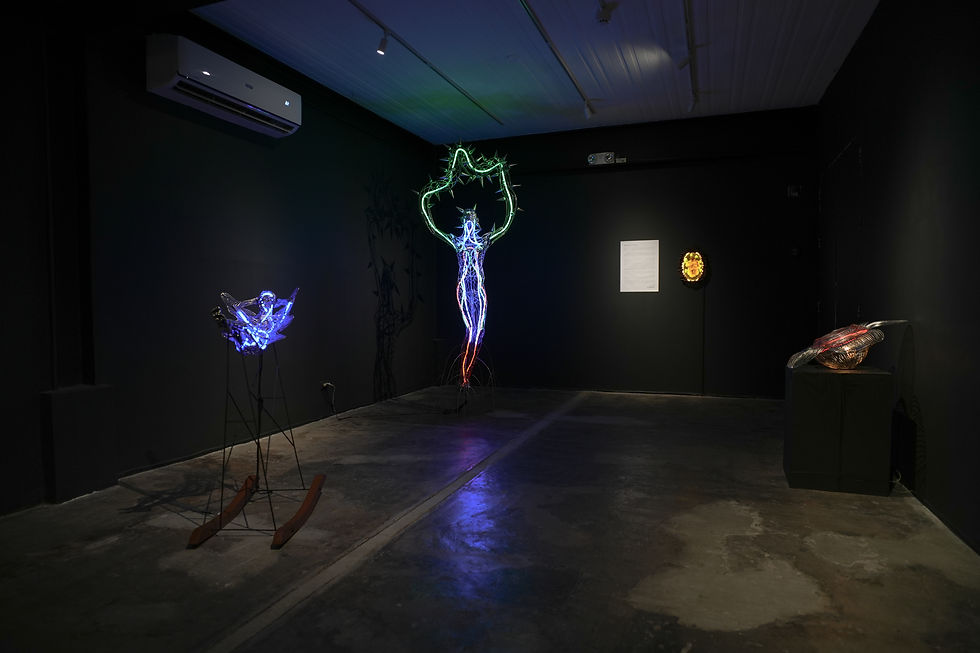
It is this quiet understanding that informs Alaala ng Lupa, Joshua Limon Palisoc's fifth solo exhibition. After the passing of his mother, the artist found comfort in the thought that she had not simply disappeared, but had returned to the natural world. The exhibition turns to nature not only as a place of mourning, but as a source of renewal.
The delicate dapo orchid in Pansamantala reflects the fragile beauty of passing moments, while the broad leaves of the badiang in Himbing offer an image of rest and refuge, their gentle rocking inviting both stillness and contemplation. Tahanan draws inspiration from the bakawan, whose intricate root systems protect coastlines while sheltering countless forms of life beneath the water's surface. Its delicate stilt and prop roots support a polished structure that feels at once light and steadfast, balancing grace with resilience. At the heart of the exhibition is Sari-buhay, inspired by the striking tayabak or jade vine, its emotional centerpiece. Here, male and female bodies merge with plant life into a single form, suggesting that identity is shaped through growth rather than certainty. Rooted in the earth, its outstretched arms blossom into new life, completing a cycle of becoming that speaks to resilience and self-acceptance. Completing the exhibition, the triptych Kapwa, Kapitbahay, and Pakisama combines human heads with the forms of pitcher plants, extending these reflections toward the relationships that bind individuals to one another and to the environments they inhabit.
Built from stainless steel, a material often associated with permanence and precision, Palisoc's sculptures undergo countless hours of cutting, bending, welding, and polishing until the metal assumes the softness and movement of living forms. The labor remains visible in every work, carrying the marks of patience, care, and sustained attention. It becomes a record of time, echoing the slow work of healing. The sculptures seem to glow from within, acquiring an unexpected warmth, as though veins of light course through translucent petals, webbed leaves, expressive faces, and caring hands. In these moments, the sculptures suggest that memory, like nature itself, is never fixed. It continues to change, carrying traces of those who came before while making room for new growth.
In Alaala ng Lupa, Palisoc creates works that return us to what is familiar. Trees, flowers, water, and home emerge as living witnesses to lives that continue beyond absence. We have always belonged to the land as much as it belongs to us. The earth receives every life that returns to it. In its quiet cycles of renewal, remembrance takes root.
- Kaye O'Yek
Joshua Limon Palisoc
Growing up in Nueva Ecija, Philippines, amid a conservative upbringing and the remnants of his parents’ junkyard business, Joshua Limon Palisoc (b. 1990) developed an early fascination with the human form and the transformative potential of materials. Encounters with wood, metal, and plastic nurtured his creative instincts, while the rigid social and religious structures of his environment fostered an introspective sensibility. This tension between control and spontaneity, logic and intuition, continues to shape his artistic practice.
Working primarily in metal, Palisoc approaches sculpture as a ritual of intention, patience, and labor. Through repetitive acts of cutting, welding, and shaping, he engages in a direct dialogue with the material, understanding the process as a form of sympathetic magic through which care, presence, and life force are transferred into the work. Influenced by his background in nursing, where he confronted the fragility of human existence, and his training in Fine Arts at the University of the Philippines, he creates sculptures that distill complex emotional and spiritual experiences through line, texture, and repetition.
Rooted in personal experiences of grief, love, and self-discovery, Palisoc’s recent works draw inspiration from Philippine endemic plants, Filipino concepts of kapwa, and animist understandings of the land as a living archive of memory and ancestry. His sculptures weave together the body, spirituality, Catholic iconography, and biodiversity, exploring themes of mortality, identity, and our relationship with the natural world.
His exhibitions—including Ephemeral Vessels (2020), Open Vessel (2021), Tahanan ng Makasalanan at Banal (2022), Ginabanal (2023), and Dambana ng Kapwa (2024)—reflect an ongoing inquiry into personal truth and the meaning of existence. Embracing contradiction as a path toward understanding, Palisoc creates works that remain open to multiple interpretations, inviting viewers to rediscover the stories held by the earth and to reflect on their own place within the shared web of life.

bottom of page