top of page

Kinabuhi
PJ Cabanalan
July 4 - July 25, 2026


1/7
KINABUHI
Kinabuhi, the Hiligaynon word for life, reflects on what years of practice have made visible. Rather than understanding life as a succession of achievements, Paul John Cabanalan sees it as a process of becoming. Clarity is earned through repetition, confidence through sustained work, and only in looking back does the path begin to reveal its own coherence.
The exhibition traces the formation of that way of seeing through the evolution of the artist's practice. The paintings from 2025—A Place Called Home and Blue Forest—retain the intuitive, painterly approach that has long characterized Cabanalan's work. Executed in a restrained monochromatic palette, they emerge through successive layers of acrylic, allowing figures, houses, trees, animals, and fragments of memory to surface gradually from textured brushwork. Rooted in recollections of his upland hometown, these works evoke the rural landscape that nurtured his earliest perceptions of place, community, and belonging. Composition remains open and exploratory, discovered through the act of painting itself.
The larger oil paintings completed in 2026—Balik Tanaw sa Isang Lumang Paaralan, May Bituin sa Loob ng Bahay, and Tatlumpu't Tatlong Taon na ng Paglalakbay at Nagpapatuloy Pa —mark a distinct shift in both process and pictorial structure. Their settings move from the rural landscapes of home toward the urban and increasingly cosmopolitan environments that shaped Cabanalan's adult life: his years as an architecture student, the communities he inhabited, and the experiences that accompanied his formation as an artist.
The earlier paintings grow. The later paintings are built.
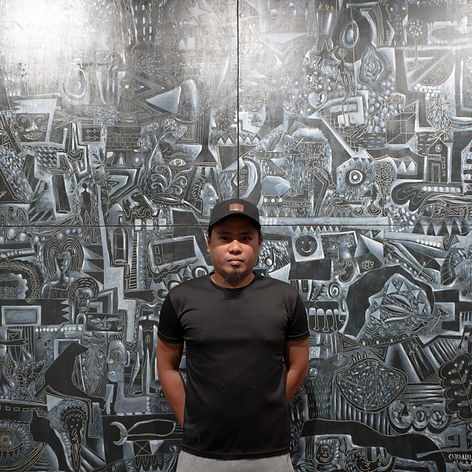
Cabanalan now begins with a deep black ground, recalling the dark interface of AutoCAD, the drafting software central to his architectural training. More significantly, his compositions are no longer formed through the gradual accumulation of layers. Instead, the picture plane is organized from the outset into distinct sectors within which figures, structures, vegetation, and symbols are deliberately situated before being elaborated with detail. Shape precedes texture. Structure precedes surface.
Rather than leaving architecture behind, Cabanalan has absorbed its way of thinking into painting.
Architecture survives here not as profession but as method. Space is organized with greater clarity, forms are held in deliberate relation, and each painting is constructed rather than accumulated. Yet this structural discipline never suppresses the vitality of the images. Instead, it reflects an artist who has grown more familiar with his own process, allowing intuition and structure to work in concert rather than in opposition.
Across the exhibition, Cabanalan maps the environments that have shaped his perception. The intimate landscapes of his rural upbringing give way to classrooms, streets, neighborhoods, and studios where his artistic life took form. Friends from architecture school, family members, neighbors, fellow artists, familiar places, plants, animals, and remembered episodes inhabit densely woven compositions that reward sustained looking. Echoes of Cubism, graphic illustration, role playing video games, and architectural drawing converge into a visual language that is unmistakably his own. These influences are neither quoted nor illustrated; they have been fully assimilated into a painterly language shaped through years of practice.
Seen in this light, the exhibition also returns to a decisive moment in the artist's life. In 2017, after passing the Architecture Licensure Examination and winning the Grand Prize at the Metrobank Art & Design Excellence (MADE), Cabanalan chose not to pursue architecture as a profession, committing himself instead to painting. Looking back, that decision appears less as a turning away from one discipline than as the gradual integration of two. Architecture did not disappear from his practice; it became embedded within it.
Cabanalan often describes his early years as an artist as a period of pangangapa—finding his way through the work itself. Today, that uncertainty has given way not to certainty, but to familiarity: a deeper trust in process, a clearer understanding of his own decisions, and the confidence to simplify without losing complexity. Even so, he remains wary of completion. Like an architectural drawing that anticipates revision, every painting leaves room for further possibility. Growth remains intrinsic to the work.
Kinabuhi is therefore less about the choice between architecture and painting than about what that choice has gradually formed. The exhibition traces not only the evolution of an artistic language but also the integration of the worlds that shaped it—nature and nurture, rural and urban, intuition and structure. It reveals that a way of seeing is cultivated by the places one inhabits, the disciplines one practices, and the life one commits oneself to.
Kinabuhi is the formation of a way of seeing—and, through it, a way of living.
- Alee Garibay
Paul John Cabanalan
A multi-awarded artist hailing from Iloilo. He obtained his BS Architecture degree from the Iloilo Science and Technology University but pursued a full-time career as a painter after successfully joining art competitions while he was still just a student.
Cabanalan describes his work like a journal, he says that each piece reveals parts of him to others - it becomes deeper as he uncovers layers of his emotions and soul. His humble beginnings as a farmer in Iloilo with a family dedicated to grind, Cabanalan recognized within himself that even with that background he believed to have always been artistically inclined.
His curiosity and talent then flourished once he set foot in high school up until his days in university. He witnessed there a wide array of talented individuals which became his inspiration instead of becoming a cause of intimidation. He was the grand prize winner of the 2017 Metrobank Arts and Design Excellence Awards, was the regional winner (Visayas region) of the 2018 Philippine Art Awards.
bottom of page