top of page

Sa Katiyakan ng Pagsikat ng Araw
Archie Oclos
October 03 - 31, 2026


1/7
When visual artist Archie Oclos (b. 1989) learned of his father’s passing in 2024, he returned to Brgy. Tinago, Catanduanes, the farming community where he grew up. The journey home required a thirteen-hour drive and a three-hour ferry crossing to the small island facing the Pacific Ocean. It also meant returning to a landscape shaped by typhoons, rural poverty, and the precarious conditions of agricultural labor.
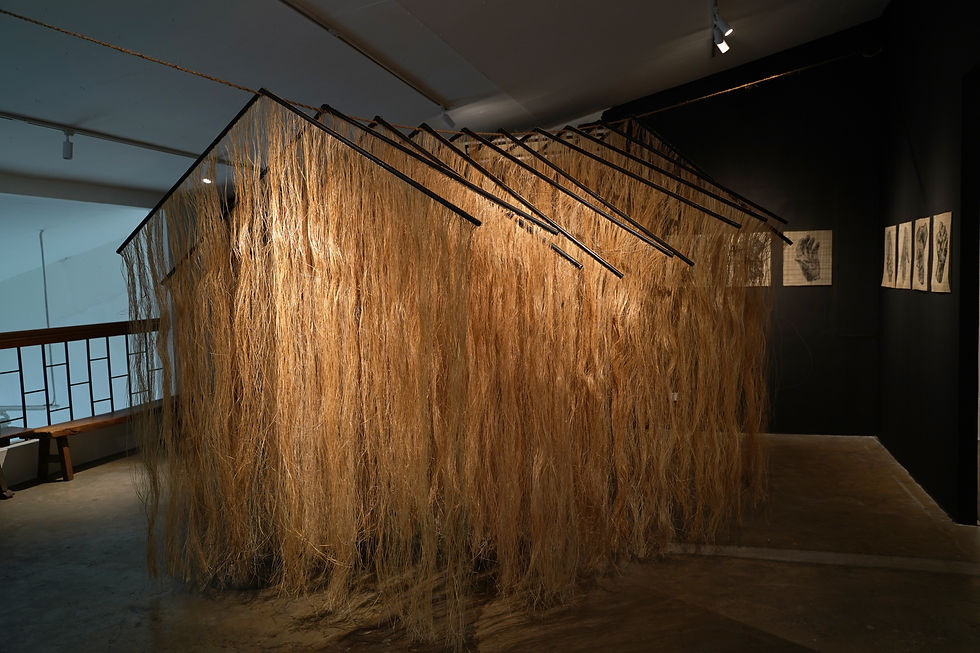
As the son of an abaca (Musa textilis) farmer, Oclos’ relationship to this place is inseparable from the material itself. He remembers removing snails from vulnerable crops as his father manually scraped the abaca pulp, while his aunts and grandmothers washed, dried, gathered, and prepared the fibers. Sa Katiyakan ng Pagsikat ng Araw returns this material to the lives and labor from which his artistic origins are founded: through oil-based ink works on handwoven abaca fibers and installation work, Oclos traces the intertwined histories of family, labor, land, and survival, where everyday objects, animals, domestic spaces, and bodily gestures are imprinted as memory. His own family and fellow townsfolk emerge within these works as subjects of remembrance, their lives embedded in the labor, relationships, and conditions that continue to shape a community where little has changed.
Abaca, internationally known as “Manila hemp,” carries histories of colonial trade, global industry, and local survival. Once exported for naval rigging and now used in currency production, the fiber remains vital in Oclos’ typhoon-stricken region, where it is woven into ropes that help secure homes. Yet for Oclos, its significance begins closer to home. The fiber carries the marks of generations who cultivated, processed, transported, and depended upon it. Its material history is therefore also a social history, connecting the intimate scale of family to larger structures of economy and power.
The repetition of hands and layered bodies creates a visual rhythm, binding individual gestures into a continuous flow of labor and movement. The rope circles through the lives of humans, animals, and nature, connecting histories and hopes. In Oclos’ hands, abaca becomes a material through which these experiences can be remembered and carried forward. Sa Katiyakan ng Pagsikat ng Araw attends to what remains: the labor that shaped a community, the losses that alter it, and the hopes that continue to move through the lives of those who remain.
- JA Balaguer

bottom of page